Showing posts with label Korak. Show all posts
Friday, July 25, 2014
Next Steps
Labels:
chaos quilt,
flying geese,
Korak
Friday, July 18, 2014
My Work Space
On this wooden board, you can see my tools. There are a few stencils I cut out of plastic boxes. The wooden board is important because I push the pins hard through the cloth layers.There is an Estonian pin cushion, wool embroidery, and the neon green thread which I use for the whole quilt. The red-framed diamond is one of four corner pieces which will be joined into the flying geese rows.
The side rows of flying gees are just being made.
The bottom picture shows the quilt at the present state.
In the lower right corner, you can see part of an older mini quilt.
Some other quilters in a quilt group saw this piece and suggested that also this one should be quilted. This is not the tradition of korak; and although I love quilting and the result and its feel, I will not do it this time. The reason is: The Korak method is based on doubled scraps. A korak naturally becomes more sturdy and stiffer than a conventional quilt top. I quilted the latest one, and it became so stiff that you can form it into sculptures that won't collapse, and it weighs a ton. I'm working on a lighter and more flexible piece this time, hoping it will be more comfy as a sleeping cover.
Labels:
chaos quilt,
flying geese,
Korak
Friday, July 11, 2014
No System
This is how far I got until now. 3 "layers", a center piece and two streets that wrap around it. The principle I tried to apply is not as striking as I thought it would be -- on the contrary, it is rather invisible. I have an idea how to continue. Starting without a plan is a risk, but making a plan has been the greater risk in my life and art.
Labels:
Korak,
planning a quilt
Thursday, July 10, 2014
Close-Up on Korak
Building up a block of strips:
What I find so fascinating about this technique: I can arrange and sew each and every part of the work on the top side.
The same part, sewn:
Diamond close-upWhat I find so fascinating about this technique: I can arrange and sew each and every part of the work on the top side.
Labels:
Korak
Monday, July 7, 2014
A Concept Arising
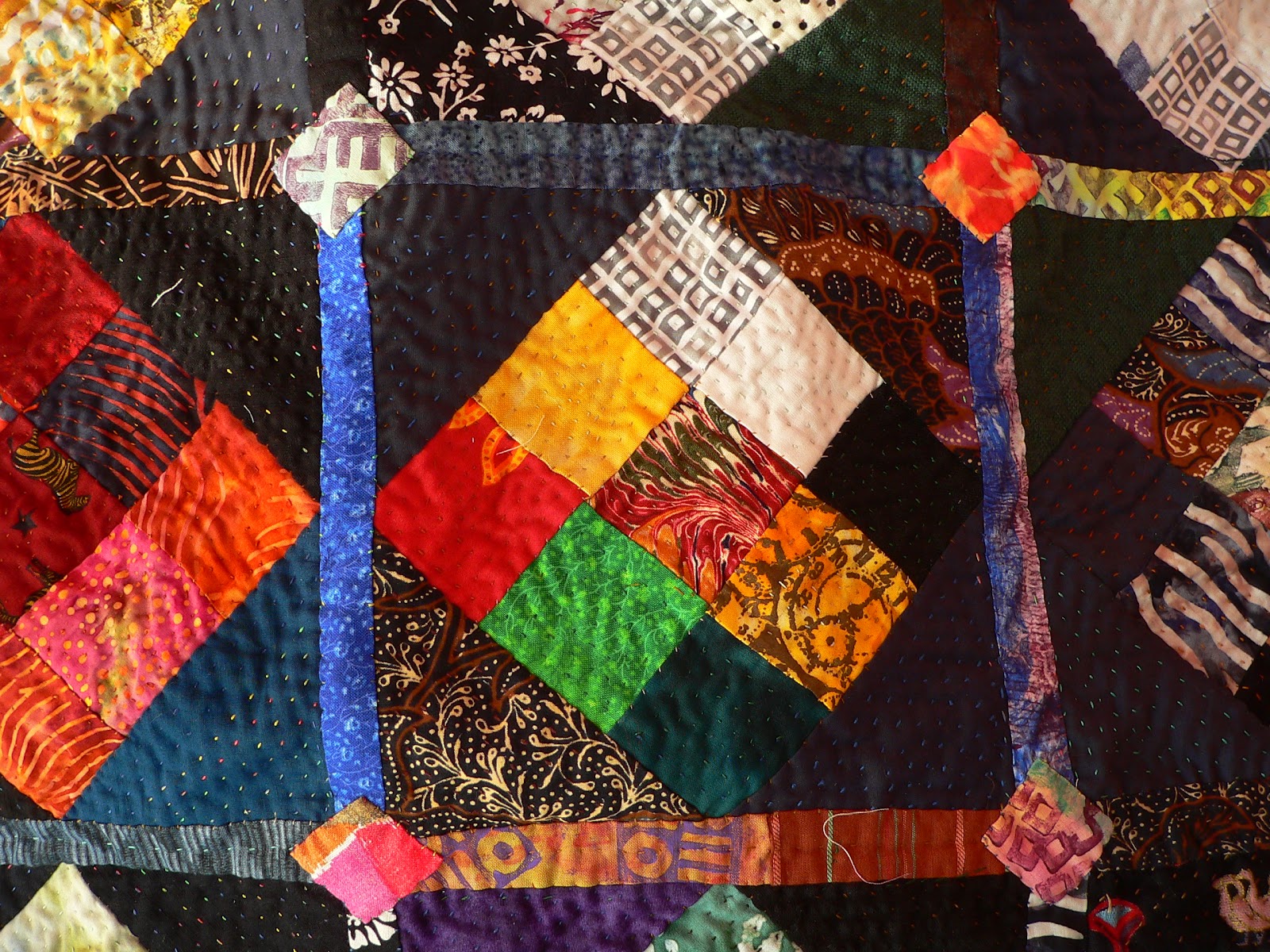
After a phase of mere experiment, a concept is forming: A rather rough diamond shape and blocks which fill the gaps between the diamonds.
The direction of the blocks is given by the central element within the light green border.
I hope to achieve a ray-light effect through the strip blocks.
I work in rows which wrap around the piece, starting in the center. So I don't have to plan the whole quilt in advance.
During my holidays, I did not have much time to quilt. Though I took the piece with me, together with a bundle of scraps and thread/needles, there was not much time to continue. Instead, my husband and I did a few walks, rode by boat, or slept a lot.
Here is a choice of pictures from our journey; see also newer postings!
The direction of the blocks is given by the central element within the light green border.
I hope to achieve a ray-light effect through the strip blocks.
I work in rows which wrap around the piece, starting in the center. So I don't have to plan the whole quilt in advance.
During my holidays, I did not have much time to quilt. Though I took the piece with me, together with a bundle of scraps and thread/needles, there was not much time to continue. Instead, my husband and I did a few walks, rode by boat, or slept a lot.
Here is a choice of pictures from our journey; see also newer postings!
Labels:
blocks,
chaos quilt,
Korak,
quilt
Thursday, June 5, 2014
No Planning -- just Chaos
No concept, just adding scraps. Maybe some day I will start planning.
I've come to using quilts as my favorite bed cover in hot summer nights and my favourite extra cover in cold winter nights.
The quilt I created before this one contains a lot of quilting which makes it very stiff. It can be shaped into a tunnel without collapsing. I started another, using the korak technique, using my husband's discarded shirt as a grid to do the piecing on. Still, everything looks skewed; seems to be a genetic disorder of mine. I will not quilt this one more than necessary, just so much that I can attach the reverse, to get a lighter and more flexible piece this time. But I may as well end up with a crib quilt for my 1-year-old grandnephew.
Labels:
Art quilts,
Korak,
quilt
Sunday, October 13, 2013
Ethnographic Quilt, Close-Up
I showed you my "Museum" or "Ethnographic" quilt more in a survey recently; now, as I proceed, I like to give you some close looks which probably make your hair stand up about the irregularities of my stitching. Actually, I don't plan, but improvise; I don't iron, but fold and press the edge with my fingernails; I keep it on my lap or on a small wooden board which you can see in some of the pictures when I find it a nuissance to cut up my thread because it went through the tablecloth.
![]() |
| I enlarge the quilt by adding strips as a support for the new piecing |
![]() |
| Instead of ironing small scraps, I fold them by sharpening
the crease with a fingernail.
|
![]() |
| Looks almost like ironed. But I did not burn my fingers. |
![]() |
| As you see, the edges are very irregular and torn, they need an equalizing strip. |
![]() |
| Fine steel pins are indispensable for this technique. |
![]() |
| I connect the pieces with very small, bead-like stitches. |
![]() |
| These bridges are split by another seam for a 3D-effect. They also make the whole piece more flexible. |
![]() |
| Sometimes I added very small appliqué bits which become 3D when surrounded by quilting stitches. |
![]() |
| Here, I integrated the appliqué into the print on the fabric. |
![]() |
| Very small scraps can be used in this mosaic piecing. |
Labels:
ethnoquilt,
Korak,
museum quilt
Thursday, September 20, 2012
WOT?
Korak piecing is fun. Printing one own fabrics is fun. But I start having doubts that both together have satisfying results. I'm not sure. Tell me: Is it a disadvantage if the pattern gets lost to this degree? I wonder should I mix my self-printed fabrics with more solids? I'm in an utterly experimental phase. ![]() |
| Linoprints, painted after printing |
![]() |
| The whole cloth, looking pretty chaotic; I thought it would get better if I cut it into small pieces... |
![]() | |
| The complete square with own prints |
![]() |
| More self-printed cloth |
![]() |
| More Estonian patterns, birds and fish |
![]() |
| A lino stamp |
![]() |
| Paint on a glass pane for monoprint, you can see the oak table though it |
And what about my latest project?
The connections of the big nine patch are done, connecting 9 nine-patches and separating them with small squares. For a bed quilt, I found out I will need 7x10 patches. Nine of seventy! Will I be able to do that? But what can you do with a 24x24" quilt? To continue is my fate.
Labels:
Korak,
lino print,
quilt
Sunday, May 8, 2011
Now there are Four Squares
sewing the corners is still a challenge, but they look better on each new sqare. This method means that the backing is included already.
Labels:
Baby quilt,
Korak
Saturday, May 7, 2011
Birdie and Bear for Bente
You may have seen these prints a long time ago, but then I wasn't able to integrate them into my quilting work. I hadn't learnt the korak method which now is my key to piecing.
I guess I'll abstain from the classic methods for good, I should have started earlier to learn them; until now, I haven't been successful with them. So you'll probably never see any classic patterns from me exept log cabin.
Labels:
Baby quilt,
Korak
Wednesday, February 23, 2011
A close look on Korak piecing
This is my totlot. You can see the method closely.I showed something like this before when the pins were getting on my nerves. I kept pricking myself and tried a basting. The result was much wonkier, too; I'm getting more experienced.
Basting is unnecessary; two pins on every patch will do.
I do not arrange more than 3-8 patches at a time, it is easier to handle.
The green base fabric will be covered completely.The contrast is helpful.
I started with large-point pins, but they catch loops of the thread all the time, small-point pins work much better.
You can imagine how fast this work proceeds.This piece can do without quilting because the stitches connect all layers.
Without a backing, all the stitches will be visible; I read that in Asia, the Korak pieces remain unbacked, showing the stitching.
Labels:
Korak
Monday, February 21, 2011
Upside down and all around
It is a good thing to try something unusual sometimes. Colors that never used to be mine -- like brown which I find very tempting at the moment. Please ignore the turquoise greens that shine through the gaps; this is the basic fabric that allows me to do the piecing. It will be covered in the end.
I apply the korak method again. The result is a 3-layer cloth which feels a lot sturdier than a normal quilt top. And it is heavy! I wonder if the Asian koraks were used to sleep under at all.
These parts are just laid out beside one another. So this is not a final choice. In the close-up, you probably can see where there are seams and where there aren't.
You may recognize the hand of my quilting friends whose mild alms make me happy.
Jens and I do reading evenings. When he comes home, we have tea and a cake, and then I read books aloud to him until supper. Last time, it was Seuphor on modern art. Much better than tv!
I apply the korak method again. The result is a 3-layer cloth which feels a lot sturdier than a normal quilt top. And it is heavy! I wonder if the Asian koraks were used to sleep under at all.
These parts are just laid out beside one another. So this is not a final choice. In the close-up, you probably can see where there are seams and where there aren't.
You may recognize the hand of my quilting friends whose mild alms make me happy.
Jens and I do reading evenings. When he comes home, we have tea and a cake, and then I read books aloud to him until supper. Last time, it was Seuphor on modern art. Much better than tv!
Labels:
Korak
Sunday, December 19, 2010
False Korak
The method I use for the reptile quilt is a kind of korak which is different from the tradition: 1. A true korak is made of doubled-up strips and squares, the squares folded diagonally, thus forming triangles. 2. A true korak will not be quilted.
Why do I abandon tradition in these two issues? (1.) Doubling up the scraps means to hide one half. Some of the fabrics I got from friends or bought long ago are too precious to be wasted. So I just fold it at the edge to create a seam, on the triangles as well. It requires only one seam, due to the method of covering the cut side with the next scrap, like laying tiles on a roof. --
Doubling the layers in smaller scraps means to stiffen the whole piece which may replace the (2.) quilting. But as I love the surface of hand quilted fabric and see this as the main purpose of quilting, I still do.
Some quilters are not so enthusiastic about the pin method. I tried basting, but it is double work since the scraps have to be held in place by pins anyway. The loop of the thread also loves to wrap around the pins. The fastest method to free it is to pull the pin out and put it back again. As always, the quilter can get used to the handling.
This is the next strip, going across the width of the quilt. Another, approximately symmetrical, will be added to the opposite side, as head and foot. This might reach the desired length already. Or some more will have to be added. Who knows? --
You're all deep in your Xmas preparations? Haha, I'm finished.
My Japanese "cousin-in-law" gave me a pin cushion. It is a kind of embroidery that is called "kogin" and comes from the Tsugaru district in Japan. Here's a book on this craft. And here are some very beautiful samples.
Why do I abandon tradition in these two issues? (1.) Doubling up the scraps means to hide one half. Some of the fabrics I got from friends or bought long ago are too precious to be wasted. So I just fold it at the edge to create a seam, on the triangles as well. It requires only one seam, due to the method of covering the cut side with the next scrap, like laying tiles on a roof. -- Doubling the layers in smaller scraps means to stiffen the whole piece which may replace the (2.) quilting. But as I love the surface of hand quilted fabric and see this as the main purpose of quilting, I still do.
Some quilters are not so enthusiastic about the pin method. I tried basting, but it is double work since the scraps have to be held in place by pins anyway. The loop of the thread also loves to wrap around the pins. The fastest method to free it is to pull the pin out and put it back again. As always, the quilter can get used to the handling.
This is the next strip, going across the width of the quilt. Another, approximately symmetrical, will be added to the opposite side, as head and foot. This might reach the desired length already. Or some more will have to be added. Who knows? --
You're all deep in your Xmas preparations? Haha, I'm finished.
My Japanese "cousin-in-law" gave me a pin cushion. It is a kind of embroidery that is called "kogin" and comes from the Tsugaru district in Japan. Here's a book on this craft. And here are some very beautiful samples.
Labels:
hand quilting,
Korak,
reptile quilt
Subscribe to:
Posts (Atom)